What Happens When You Reduce Added Sugar: The Inflammation Connection
74% of packaged foods sold in U.S. supermarkets contain added sugar. Salad dressing. Pasta sauce. Whole-grain bread. “Healthy” yogurt. Most of it isn’t in the foods you think of as sweet, which is why the average American eats nearly 3x the recommended daily limit without realizing it.
Excess added sugar drives chronic, low-grade inflammation — and that inflammation shows up as joint pain, dull skin, afternoon crashes, and stubborn midsection weight. Here’s what actually changes when you cut it back, symptom by symptom, with the timelines and the grocery-store fix that does most of the work.
Short on Time? Here’s What to Know
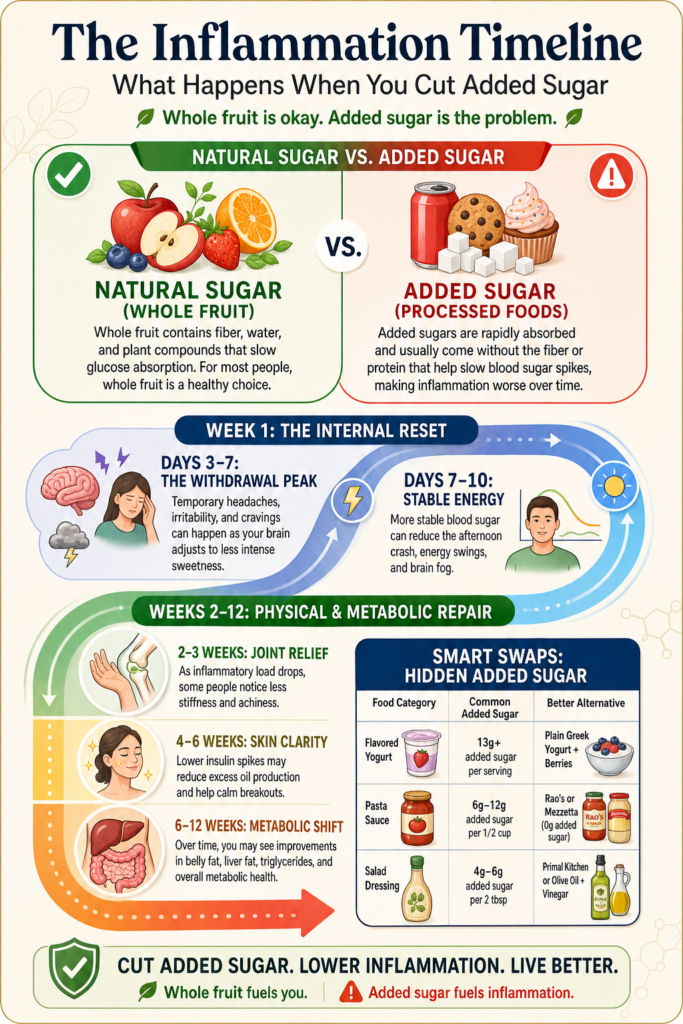
- When you reduce added sugar, inflammation drops within weeks, not months. Energy stabilizes in 7–10 days. Joint pain and CRP (your main inflammatory marker) improve in 2–3 weeks. Skin clarity shifts in 4–6 weeks. Visceral fat and triglycerides reduction take 6–12 weeks.
- You don’t have to cut sugar to zero. The U.S. average is 17 teaspoons daily; the American Heart Association limit is 6 teaspoons for women and 9 for men. The biggest inflammation drop happens between 17 teaspoons and 6 — not between 6 and zero.
- Whole fruit is not the problem — added sugar is. The fructose in apples and berries comes packaged with fiber, water, and polyphenols that prevent the inflammatory spike. Whole fruit intake is associated with lower inflammatory markers in the research, not higher. The fructose-and-inflammation story applies to sugar-sweetened beverages, syrups, and processed foods — not produce.
- Most hidden added sugar is in foods that don’t taste sweet. Pasta sauce, yogurt, salad dressing, bread, granola, and coffee creamer are the biggest hidden contributors. Reading the “Added Sugars” line on the Nutrition Facts label is most of the intervention. My 3 favorite no-added-sugar swaps: Rao’s Homemade Marinara, Primal Kitchen dressings 3-pack, and Fage Total 5% Plain Greek Yogurt.
- I break down the full hidden-sugar grocery store fix below — including what to look for on the label, sugar’s 60+ aliases, and the 7 packaged foods with the most hidden added sugar.
This post may contain affiliate links to products that align with my evidence-based nutrition approach. As an Amazon Associate I earn from qualifying purchases. Full disclosure.
How Added Sugar Causes Inflammation
The U.S. Dietary Guidelines recommend keeping added sugar under 50 grams (12 teaspoons) per day. The American Heart Association is stricter: under 25 grams (6 teaspoons) for women, 36 grams (9 teaspoons) for men. A single 20-ounce soda contains about 65 grams — more than 2.5x the daily limit for women, in one drink.
When you eat that much added sugar regularly, three things happen to your body:
A quick clarification before we get into it: complex carbohydrates from whole grains, legumes, vegetables, and fruit are not the issue here. Your brain and body need glucose, and the gentle, fiber-buffered rise from those foods doesn’t drive the same inflammatory response. The story below is specifically about added sugar — the concentrated kind your body never evolved to handle in modern doses.
1. Sharp blood sugar spikes keep your inflammation system stuck “on.” Blood sugar is supposed to rise after a meal — that’s normal. The issue is how it rises. Sugary drinks and processed foods spike it sharply because there’s no fiber, protein, or fat to slow absorption. Each sharp spike nudges on your body’s main inflammation switch (a protein called NF-κB). Do it three or four times a day for years, and the alarm never resets.
2. Sugar literally stiffens the proteins in your skin, joints, and arteries. Sugar molecules bind to collagen and form damaged, stiffer versions called AGEs (advanced glycation end-products) — the same chemistry that browns the crust on a baked good, except it’s happening on proteins your body can’t easily replace. This is why high-added-sugar diets accelerate wrinkles, joint stiffness, and arterial damage at the same time.
3. Fructose hits your liver the way alcohol does. Fructose — the sugar in soda, juice, and high-fructose corn syrup — goes almost directly to your liver. When it floods in from sugar-sweetened drinks day after day, your liver converts the overflow into fat. That’s the pathway to non-alcoholic fatty liver disease, the most common chronic liver condition in the U.S.
Two of these pathways are highly responsive to dietary change. The third — AGE accumulation — slows dramatically when you cut back, but already-glycated proteins take time to turn over. Either way, the symptom changes show up faster than most people expect.
The 6 Things That Happen When You Cut Added Sugar
Different symptoms respond on different timelines because they’re driven by different mechanisms. Here’s what the research actually shows, organized by what most people notice first.
1. Joint pain and stiffness
If you’ve been dealing with joint stiffness that’s worse on some days than others — and your doctor has ruled out structural damage — there’s a strong chance some of it is being driven by inflammatory cytokines that respond directly to added sugar intake.
The Arthritis Foundation has explicitly named added sugar as one of the most consistently identified dietary triggers for inflammatory arthritis flares. The mechanism is the AGE/RAGE pathway plus glucose-spike-driven cytokine release. In one survey of over 200 people with rheumatoid arthritis, sugar-sweetened soda and desserts were the two foods most frequently reported as worsening symptoms.
Timeline: Most people who reduce added sugar without changing anything else notice improvements in joint stiffness within 2 to 3 weeks. That timing aligns with the inflammatory-marker response window seen in controlled feeding trials.
2. Skin clarity and aging
The skin story is the most direct application of the AGE pathway. Glycated collagen is stiffer, less elastic, and resistant to normal turnover. That’s the molecular version of what dermatologists describe clinically as “sugar face” — the dullness, slackness, and accelerated wrinkling associated with high-glycemic diets.
Acne has its own pathway. High-glycemic-load diets drive insulin and IGF-1 elevation, which increases sebum production and androgen activity at the skin level. A 2022 systematic review in JAAD International found that low-glycemic-load diets were associated with reduced acne severity compared to high-glycemic-load controls.
Timeline: Clarity and breakouts typically improve within 4 to 6 weeks. Elasticity changes take longer because collagen turns over slowly — what shifts faster is the rate at which new AGEs form.
3. Energy and brain fog
The 3 p.m. crash isn’t a sleep problem or a willpower problem — it’s a glucose-rollercoaster problem. A meal or drink heavy in added sugar (and light on fiber, protein, or fat) drives a sharp insulin response that then pushes blood sugar below where it started. That post-meal dip is the physiological substrate of brain fog, irritability, and the desperate search for a snack 90 minutes after lunch.
When added sugar drops, glucose curves flatten. Stable glucose means stable energy means stable focus. In a tightly controlled trial, just 9 days of restricted dietary fructose (with calories held constant) significantly improved insulin sensitivity in obese adolescents with metabolic syndrome. The same mechanism applies in adults.
Timeline: This is one of the fastest changes most people notice. Within 7 to 10 days of reducing added sugar (and pairing remaining carbs with protein and fat), most people report fewer afternoon crashes and steadier all-day energy. It’s measurable on a continuous glucose monitor — not a placebo.
4. Gut health and bloating
Diets high in added sugar shift the gut microbiome toward less favorable populations — more pro-inflammatory species, fewer of the short-chain-fatty-acid producers that maintain gut barrier integrity. A 2020 study at UT Southwestern found that a high-sugar diet alters gut microbial populations within just seven days, accelerating the growth of mucus-degrading bacteria.
When the gut barrier loosens, bacterial fragments leak into the bloodstream and trigger more inflammation through the same NF-κB pathway. The gut isn’t a separate inflammation story; it’s another route into the same fire.
Timeline: Reducing added sugar — particularly when fiber intake goes up because sugary foods get displaced by whole foods — tends to reduce bloating and normalize bowel patterns within 2 to 4 weeks.
5. Belly fat and visceral fat
Visceral fat (the deep belly fat that surrounds your organs) is metabolically distinct from subcutaneous fat. It’s hormonally active, drives insulin resistance, and produces its own inflammatory cytokines. It also responds disproportionately to added sugar — particularly fructose.
In a 9-day study of obese children with metabolic syndrome (Schwarz et al., 2017), researchers swapped dietary sugar for starch while keeping total calories identical. Median liver fat dropped from 7.2% to 3.8%, visceral fat decreased significantly, and insulin sensitivity improved — all with no weight loss. That’s not a weight-loss study — it’s a body-composition study showing that the type of carbohydrate matters independent of total calories.
For midlife women specifically — when declining estrogen redistributes fat from hips to abdomen — reducing added sugar is one of the most effective dietary changes for visceral fat in this group. It works alongside (not instead of) strength training and adequate protein intake.
Timeline: Most people see visible midsection changes within 6 to 8 weeks of consistent sugar reduction.
6. Cholesterol, triglycerides, and cardiovascular markers
The cholesterol and triglyceride story tracks the liver story. When the liver isn’t being asked to convert excess fructose into fat, it stops shipping out as much VLDL — the precursor to small, dense LDL particles and elevated triglycerides. Studies have consistently shown that added sugar reduction lowers triglycerides and improves the overall lipid profile within 6 to 12 weeks.
For perimenopausal and postmenopausal women — when cardiovascular risk rises sharply due to declining estrogen — this is one of the most effective dietary changes available.
A 2023 study using 18 years of follow-up data from the Nurses’ Health Study and Health Professionals Follow-Up Study found that replacing just one daily serving of a sugary beverage with water, coffee, or tea lowered overall risk of developing type 2 diabetes by 2% to 10%. For people who already had diabetes, that single swap reduced cardiovascular-related death risk by 24%.
Timeline: Triglycerides typically respond within 6 to 12 weeks. CRP shifts faster — often within 2 to 4 weeks of consistent reduction.
Sugar Withdrawal: What to Expect Days 3 to 7
When you sharply reduce added sugar, particularly if you’ve been a high consumer, expect 3 to 7 days of headaches, fatigue, irritability, intense cravings, and sometimes mild brain fog. This is real and frequently reported — not a sign you’re failing. It’s likely a combination of dopamine-circuit recalibration (sugar drives dopamine release, and human craving patterns appear to track an adjustment curve in some research) and the metabolic shift away from constant glucose availability.
The withdrawal phase peaks around days 3 to 5 and resolves within a week for most people. What helps:
- Don’t cut everything at once. Whole-fruit sugar isn’t the issue. Keep berries, apples, and citrus.
- Eat protein at every meal. A breakfast with 25 to 30 grams of protein dramatically reduces afternoon cravings.
- Hydrate aggressively. A surprising amount of “sugar withdrawal” symptoms are just dehydration, since high-sugar diets often pair with low water intake.
- Sleep. Sleep deprivation increases preference for high-calorie, high-carbohydrate foods the next day in both behavioral and brain-imaging studies. Cutting sugar is harder on 5 hours of sleep than on 8.
After day 7, most people describe a noticeable shift: cravings drop sharply, sweet foods start tasting too sweet, and the low-grade hunger many people report on high-added-sugar diets begins to lift.
Hidden Added Sugar: The Grocery Store Fix
This is where most sugar-reduction efforts fail. People remove the obvious stuff — soda, candy, dessert — and assume they’re set, then keep eating easily 30+ grams of hidden added sugar a day from foods they don’t think of as sweet.
Reading the label correctly does most of the work.
How to read a nutrition label for added sugar
Since 2020, the Nutrition Facts panel has been required to list “Added Sugars” as a separate line under “Total Sugars.” This is the single most useful label change in the past decade — it tells you exactly how much sugar was put there during processing versus how much occurs naturally.
- Added Sugars line: aim for under 5 grams per serving. Some categories (yogurt, bread, sauce) should be at or near 0 grams.
- Ingredients list: sugar should be below 5th place. If sugar (or any of its 60+ aliases) is in the first three ingredients, it’s a sugar product wearing a different costume.
- Watch for sugar’s aliases. Cane juice, evaporated cane sugar, brown rice syrup, agave nectar, fruit juice concentrate, dextrose, maltose, sucrose, and high-fructose corn syrup are all added sugar by another name. “Organic cane sugar” is still added sugar.
- “No added sugar” labels are usually accurate — but check that the product hasn’t replaced sugar with sugar alcohols (sorbitol, maltitol, xylitol) that cause GI distress in many people.
7 packaged foods with the most hidden added sugar
Yogurt. Standard flavored yogurt is one of the worst offenders. A single 6-ounce strawberry Yoplait Original contains 13 grams of added sugar — more than half of a woman’s daily AHA limit, in one cup. Buy plain yogurt (Greek or regular) and add your own berries. Plain Stonyfield, Fage, Chobani plain, or store-brand plain Greek yogurt all work.
Pasta sauce. Most major brands of marinara contain 6 to 12 grams of added sugar per half-cup serving. Skip: Ragu Traditional, Prego Traditional, most Bertolli flavors. Look for: Rao’s Homemade Marinara (0g added sugar), Mezzetta Napa Valley Bistro (0g), or any brand whose ingredient list reads tomatoes /
Bread. Most commercial sliced bread contains 1 to 4 grams of added sugar per slice, and most people eat 2 slices at a time — so a sandwich is often a hidden 4 to 8 grams of added sugar before you’ve added anything to it. Brands that don’t add sugar: Ezekiel 4:9 Sprouted Grain (0g added sugar), Dave’s Killer Bread Powerseed (1g per slice), and most fresh bakery sourdough (typically 0 to 1g). Skip: Sara Lee Soft & Smooth, most Pepperidge Farm varieties, and anything with “honey” in the name (it’s still added sugar).
Salad dressing. Bottled dressings frequently contain 4 to 6 grams of added sugar per 2-tablespoon serving. Skip: most “honey” dressings, Catalina, French, balsamic vinaigrettes from major brands. Look for: Primal Kitchen (0g added sugar across most flavors), Tessemae’s, or just make your own (3 parts
Granola and “healthy” cereals. This is where the wellness-aisle marketing diverges most sharply from the nutrition label. Many commercial granolas contain 8 to 15 grams of added sugar per half-cup serving — and most people pour double a half-cup serving for breakfast. Look for: Purely Elizabeth Original Ancient Grain (5g added sugar), Bob’s Red Mill Old Country Style Muesli (0g added sugar). Skip: Nature Valley Protein Granola, Kashi GoLean Crisp, most Bear Naked flavors.
Flavored coffee creamer. A 2-tablespoon serving of Coffee-Mate French Vanilla contains 5 grams of added sugar — and most people use 3 to 4 tablespoons per cup. Two cups a day puts you at 10 to 20 grams of added sugar before breakfast. Switch to: unsweetened oat milk, unsweetened almond milk, plain half-and-half, or whole milk with a quarter teaspoon of cinnamon and vanilla extract.
Plant-based milks. Vanilla and “original” varieties typically contain 5 to 7 grams of added sugar per cup. Always buy the unsweetened version, which has 0 to 1 grams. The price is the same.
The 30-second shopping rule
Read the Added Sugars line on the Nutrition Facts panel before reading anything else on the package. If it’s above 5 grams per serving and the product isn’t dessert, put it back. The marketing on the front of the box does not matter. The Added Sugars number is the only number that matters.
How to Reduce Added Sugar Without Making It a Project
The most sustainable version of sugar reduction is the one that doesn’t feel like a project. Five practical steps:
1. Pick one category at a time. Don’t try to overhaul yogurt, bread, sauce, dressing, and creamer in the same week. Pick whichever category you eat most often and replace it with a low-sugar alternative. The next week, pick another. Within two months you’ve remade your pantry without ever feeling deprived.
2. Use the Added Sugars line, not the Total Sugars line. A cup of plain yogurt with raspberries shows 14 grams of total sugar but 0 grams of added sugar — that’s a great breakfast. A cup of strawberry-flavored yogurt shows 22 grams of total sugar with 18 grams of added sugar — that’s a dessert.
3. Keep whole fruit. Whole-fruit sugars come packaged with fiber, water, and polyphenols that completely change the metabolic response. Eat the apple. Eat the berries. The “fruit is sugar” claim is the single weakest argument in the wellness-internet playbook.
4. Don’t replace sugar with sucralose. Most artificial sweeteners don’t fix the underlying problem; they preserve the dopamine-circuit dependency on intense sweetness, which is part of why sugar cravings persist on diet soda. If you need a sweetener, monk fruit and stevia are the cleanest options. Better long-term: gradually re-train your palate by reducing the intensity of sweetness across the board.
5. Plan for the withdrawal week. Days 3 to 5 will be harder than you expect. Schedule them for a low-stress week if you can. Stock high-protein breakfasts. Sleep more. It passes.
Why This Story Gets Misrepresented
The “sugar is poison” framing oversimplifies the science, and the “sugar is fine in moderation” framing underrepresents how much of it the average American is actually eating. The accurate version is in between: added sugar is one of the most well-documented dietary drivers of chronic inflammation we have, the dose-response is real, and the average American is consuming far more than the level at which inflammation begins to climb.
It’s also not a moral issue. Added sugar isn’t evil and you don’t need to feel guilty about cake at a birthday party. The question is what’s running through your bloodstream the other 364 days of the year — and how much of the ongoing low-grade inflammation you’ve been blaming on aging, stress, or “just getting older” is actually a slow-motion added-sugar story you’ve been quietly running for a decade.
The fix is not dramatic. Move closer to the AHA limit, read the Added Sugars line, displace the obvious culprits one at a time, and let the inflammation timeline run.
Frequently Asked Questions
How long does it take to feel better after cutting added sugar?
Different symptoms respond on different timelines. Energy and afternoon crashes improve within 7 to 10 days. Cravings drop sharply after day 7. Joint pain and inflammatory markers like CRP show measurable change within 2 to 3 weeks. Skin clarity (acne, dullness) shifts in 4 to 6 weeks. Visceral fat and triglycerides take 6 to 12 weeks. Skin elasticity changes take longer because collagen turns over slowly.
Do I need to cut sugar completely?
No, and most people who try fail within two weeks. The research on inflammation and added sugar is dose-dependent — moving from 17 teaspoons a day (the U.S. average) to 6 teaspoons (the AHA limit for women) produces most of the inflammatory benefit. The marginal benefit of going from 6 teaspoons to 0 is small and not worth the social and psychological cost for most people. Aim for the AHA limit on most days. Birthday cake at a birthday party is not the variable driving your inflammation.
Are artificial sweeteners a good substitute?
Mostly no. Artificial sweeteners (sucralose, aspartame, saccharin) don’t deliver calories, but they preserve the dopamine-circuit dependency on intense sweetness, which is part of why sugar cravings often persist on diet soda. If you need a sweetener, monk fruit and stevia are the cleanest options. Better long-term: gradually re-train your palate to tolerate (and prefer) less-sweet foods. After a few months of reduced sugar intake, most people find that previously normal foods taste cloying.
What’s the difference between “natural” sugar and “added” sugar on a label?
Total Sugars on a Nutrition Facts panel includes both — the naturally occurring sugars in the food (like the fructose in fruit or the lactose in milk) plus any sugars added during processing. Added Sugars is a separate line and tells you only the processed-in amount. For inflammation purposes, the Added Sugars number is the one to track. A plain Greek yogurt might show 6g total sugar (all natural lactose) and 0g added sugar — that’s a low-sugar food. A flavored yogurt might show 22g total sugar and 18g added sugar — that’s a dessert.
What about honey, maple syrup, and agave — are those better than regular sugar?
Yes and no. From an inflammation standpoint, your liver and bloodstream process them similarly to table sugar — same glucose and fructose load, same NF-κB activation. They all count as “added sugar” on the Nutrition Facts label and they all need to fit within your AHA limit. Calorie for calorie, they’re not “free passes.”
That said, less-processed sweeteners (raw honey, real maple syrup, blackstrap molasses, sucanat, sugar in the raw) do contain trace minerals, antioxidants, and other compounds that fully refined white table sugar has been stripped of. Raw honey has well-documented antimicrobial and wound-healing properties, and small studies have explored its role in seasonal allergies — though the evidence is mixed and major allergy organizations don’t currently consider local honey a proven treatment. Manuka honey in particular — like Manuka Health UMF 10+/MGO 263+ — has been studied for its antibacterial activity at higher MGO levels, and it’s the one I keep in my kitchen for sore throats and topical use. Blackstrap molasses contains meaningful amounts of iron, calcium, and magnesium. White table sugar contains none of these and offers no nutritional benefit beyond calories.
So the honest answer: if you’re going to use a sweetener, the less-processed options are a better choice than white sugar — but they’re not a free pass on the inflammation side. I’m working on a deeper guide to sugar substitutes — coming soon.
Will cutting sugar help me lose weight?
It can, particularly visceral fat, but it’s not guaranteed. Sugar reduction reduces total calorie intake for most people because high-sugar foods are calorie-dense and not satiating, and it specifically reduces visceral and liver fat through the fructose-to-liver pathway described earlier. But if you replace the calories from sugar with other low-quality foods, the scale may not change much. Sugar reduction works best for body composition when paired with adequate protein intake, fiber, and strength training.
This article is for educational purposes and should not replace medical advice. If you have diabetes, are on medications that affect blood sugar, or have a history of disordered eating, work with your healthcare team before making major dietary changes.