Is Oatmeal Bad for You? A Dietitian Sets the Record Straight
Short answer: No, oatmeal is not bad for you. Rolled and steel-cut oats are scientifically proven to lower LDL cholesterol, improve blood sugar control, and reduce inflammatory markers — backed by meta-analyses of dozens of randomized controlled trials and an FDA-authorized health claim that very few foods have ever earned.
So why are influencers telling you oatmeal “spikes your blood sugar,” “feeds candida,” or is “secretly inflammatory”? Because it’s the standard nutrition-misinformation playbook: take a kernel of truth (instant flavored packets do spike blood sugar), strip the context, and build a scare campaign around it. The same template gets used against legumes, bananas, and many foods with the strongest evidence base behind them.
Here’s what frustrates me as a dietitian: oats are genuinely beneficial, and the people who need them most — women dealing with rising cholesterol in perimenopause, anyone managing blood sugar, anyone with chronic inflammation — are the ones being scared away from a food that’s actively working in their favor.
Below, I’ll walk you through what the evidence actually says about oatmeal and blood sugar, inflammation, antinutrients, gluten, and cholesterol — including the one real concern (gluten cross-contamination) that applies to one specific group. Then I’ll show you the simple way to optimize your bowl, name the instant oatmeal products worth skipping, and tell you what to buy instead.
This post may contain affiliate links to products that align with my evidence-based nutrition approach. As an Amazon Associate I earn from qualifying purchases. Full disclosure.
Does Oatmeal Spike Your Blood Sugar?
Rolled and steel-cut oats are clinically proven to improve blood sugar control, not worsen it.
A systematic review and meta-analysis in Nutrients analyzed 14 controlled trials of people with type 2 diabetes and found that regular oat intake significantly reduced fasting blood glucose and HbA1c (Hou et al., 2015). The doses across these trials were realistic — most studies used about ½ to 1 cup of dry oats per day (one normal breakfast bowl) over 4 to 12 weeks. A second meta-analysis focused specifically on the active fiber found that the amount of beta-glucan in roughly ¾ cup of dry oats per day, eaten daily for 3 to 8 weeks, lowered fasting glucose and HbA1c (Shen et al., 2016).
One bowl. Daily. For a couple of months. That’s the protocol that’s been studied — and it works. HbA1c is a three-month average of blood sugar, so you can’t fake it. If oats spiked blood sugar the way critics claim, daily oatmeal would have made these patients worse, not measurably better.
So where does the “oatmeal spikes your blood sugar” claim come from? It contains a kernel of truth — which is what makes it effective misinformation.
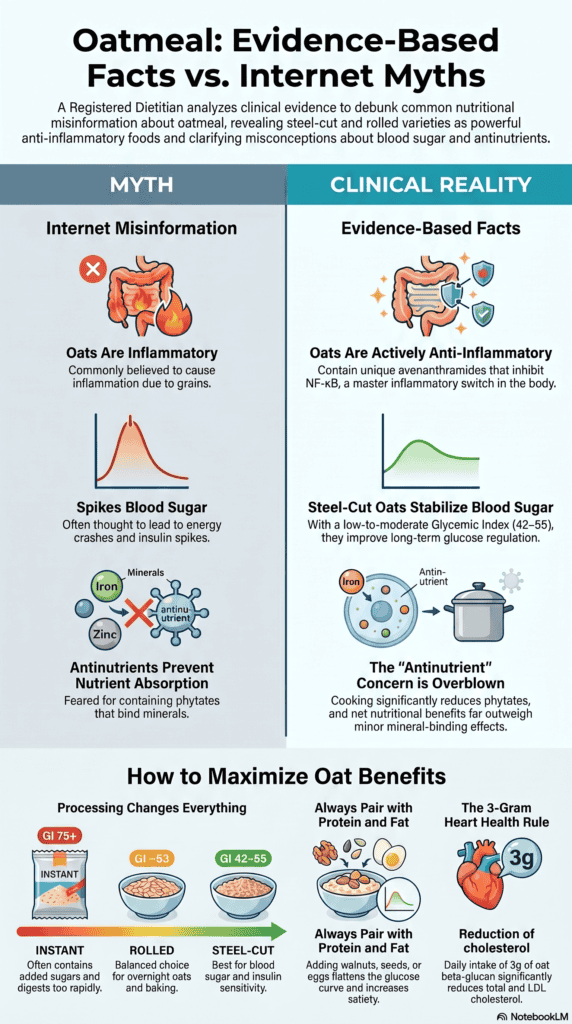
Instant oatmeal (the packets with added sugar and flavoring) can have a glycemic index around 75. Quick translation: glycemic index is a 0-to-100 score that ranks how fast a food raises your blood sugar. Pure glucose is 100 (the fastest). Anything 70 and above is considered “high” — the food breaks down quickly, blood sugar rises sharply, your body releases a big shot of insulin, and you crash an hour later. Foods 55 and below are considered “low” — slow release, steady energy, no crash. So yes, instant oatmeal at 75 is high. That’s real. But critics take that data point and apply it to all oatmeal, which is like saying all apples are unhealthy because Apple Jolly Ranchers exist. The processing changes the food entirely.
In a systematic review of glycemic-index measurements across oat types, steel-cut oats had a mean glycemic index of about 55, large-flake (rolled) oats about 53, and quick-cooking and instant oats came in at 71 and 75 respectively (Tosh & Chu, 2015). Some clinical studies report steel-cut values as low as 42, depending on cooking method and pairing. So steel-cut and rolled oats sit in the low-to-moderate range — comparable to many fruits and legumes — while only the heavily processed instant varieties cross into the “high” category.
What makes oats this effective on blood sugar is beta-glucan, the soluble fiber that gives oatmeal its thick, gel-like texture. When beta-glucan hits liquid in your gut, it forms a viscous gel that physically slows how fast your stomach empties and how fast glucose enters your bloodstream. Slower release means smaller spikes, smaller insulin response, and steadier energy. (For more on why post-meal blood sugar spikes drive inflammation in the first place, see my guide on what happens when you reduce added sugar.)
So: instant packets with 12 grams of added sugar eaten alone on an empty stomach? Yes, that produces a glucose spike. Steel-cut oats with walnuts and blueberries? The research is decisive. They stabilize blood sugar.
🚩 The myth: “Oatmeal spikes your blood sugar just like eating white toast or cereal.”
The reality: Steel-cut and rolled oats sit in the low-to-moderate glycemic range and contain beta-glucan fiber that’s clinically proven to improve glucose regulation. The criticism applies to heavily processed instant varieties — not oats themselves.
Is Oatmeal Inflammatory?
Oats are actively anti-inflammatory. They’re not neutral, and the research doesn’t say they “may help” — they actively work against the inflammatory pathways that drive joint pain, skin flares, gut inflammation, and cardiovascular damage.
That’s because oats contain a class of polyphenols called avenanthramides. These compounds are found at meaningful concentrations only in oats — they’re absent or trace in wheat, barley, rye, and other common grains.
Avenanthramides inhibit NF-κB, one of your body’s master inflammatory switches. They help block the degradation of IκB-α (the protein that keeps NF-κB in check), reduce TNF-α-induced inflammatory signaling, and suppress production of pro-inflammatory cytokines including IL-8 (Sur et al., 2008).
Here’s a way to picture that: think of NF-κB as the master alarm switch for inflammation inside your cells, and IκB-α as the safety pin that keeps it in the off position. When stress hits — toxins, poor diet, intense exercise — the safety pin gets degraded, the alarm flips on, and your cells start producing the inflammatory chemicals you eventually feel as joint pain, skin flares, or gut discomfort. Avenanthramides help keep that safety pin intact, so the alarm never sounds in the first place. They don’t put out a fire — they prevent it from starting.
And the benefits go beyond reducing inflammatory markers on a lab report. Avenanthramides have documented effects on things you actually feel:
Skin irritation and itching. Oat avenanthramides showed anti-itch activity comparable to hydrocortisone in laboratory testing. Colloidal oatmeal is FDA-approved as a skin protectant specifically because of its anti-inflammatory effects on the skin barrier — helping with eczema, dermatitis, and other inflammatory skin conditions (Sur et al., 2008). If you deal with skin inflammation, oats are working for you, not against you.
Exercise recovery. A randomized controlled trial in the European Journal of Applied Physiology showed that consuming avenanthramide-enriched oats reduced exercise-induced inflammation (Koenig et al., 2016). Less post-workout soreness. Faster return to full function. That matters if you’re trying to stay consistent with movement.
Cardiovascular protection. Avenanthramides reduce the expression of adhesion molecules in blood vessel walls — an early step in atherosclerosis development. They also inhibit pro-inflammatory cytokines in coronary artery endothelial cells (Liu et al., 2004). A 2018 review of avenanthramide research summarized these findings alongside evidence for vasodilation, antiproliferative effects on vascular smooth muscle cells, and broader cardioprotective activity (Perrelli et al., 2018). Combined with the cholesterol-lowering effects of beta-glucan, this makes oats one of the most cardiovascular-protective foods available. (For the full picture on how diet calms cardiovascular inflammation, see my guide on high blood pressure and inflammation.)
Gut health. A systematic review of 84 studies found that oat intake increased beneficial Lactobacillus and Bifidobacterium populations, enhanced short-chain fatty acid production, and supported gut barrier integrity in people with and without GI conditions (Valido et al., 2021). Your gut bacteria thrive on beta-glucan. And a thriving gut microbiome is your first line of defense against systemic inflammation — I cover that connection in detail in my post on the gut-brain connection.
When someone tells you oatmeal is “inflammatory,” ask them to name a single clinical study supporting that claim. They won’t have one. The actual evidence shows the opposite — oats are actively anti-inflammatory across skin, gut, cardiovascular, and exercise-recovery contexts.
🚩 The myth: “Oats are inflammatory because they’re a grain.”
The reality: First, grains aren’t inherently inflammatory. Whole grain intake is consistently associated with lower inflammatory markers in the research, not higher — the carb-fear narrative against all grains doesn’t hold up to clinical data. Second, oats specifically contain avenanthramides — anti-inflammatory polyphenols found at meaningful concentrations only in oats — that inhibit NF-κB and reduce inflammatory cytokines. Clinical and laboratory evidence supports anti-inflammatory effects across skin, gut, cardiovascular, and exercise-recovery contexts.
Do Oats Have Antinutrients?
The antinutrient argument is a carnivore-and-ancestral-diet talking point that doesn’t hold up to scrutiny. Here’s the claim: oats contain phytates (phytic acid) and oxalates, which bind minerals and reduce absorption. Therefore — they argue — oats are secretly depleting you of iron, zinc, and calcium.
Three things they leave out.
First, cooking oats reduces phytate content significantly. Soaking, fermenting, and heat processing all degrade phytic acid. Since nobody eats raw steel-cut oats, this concern is largely addressed before the oatmeal hits your bowl.
Second, phytic acid isn’t a villain. Modern research has documented antioxidant activity, kidney-stone prevention, and potential anti-cancer effects. The “antinutrient” label is misleading shorthand for a compound that does both.
Third — and this is the part the influencers won’t tell you — the nutritional benefits of oats (fiber, minerals, protein, avenanthramides, beta-glucan) far outweigh any marginal reduction in mineral absorption from phytates. The broader evidence consistently links whole grain intake, including oats, to better nutritional status and lower disease risk. Not worse. (This same flawed framing gets used against many plant foods. I broke it down in detail in my post on whether the carnivore diet is anti-inflammatory.)
If mineral absorption is genuinely on your mind, here’s the fix: top your oats with vitamin C–rich fruit (berries, citrus, kiwi). Vitamin C dramatically enhances iron absorption from plant foods and overrides whatever small amount of phytic acid survives cooking. Done. That’s the entire intervention.
🚩 The myth: “Oats are full of antinutrients that steal your minerals.”
The reality: Cooking reduces phytates significantly. The net nutritional benefit of oats — fiber, beta-glucan, avenanthramides, and minerals — far exceeds any marginal absorption reduction. Pair with vitamin C and the issue is moot.
Are Oats Gluten-Free?
Oats are naturally gluten-free. The plant doesn’t contain wheat, barley, or rye gluten — it’s a botanically distinct grain. The legitimate concern is cross-contamination: conventional oats are often processed in facilities that also handle wheat, which can introduce trace gluten.
For people with celiac disease, that trace contamination matters. Even microscopic amounts of gluten can trigger intestinal damage. The fix is straightforward: choose certified gluten-free oats , which are processed in dedicated facilities and tested to under 20 ppm — the FDA threshold for the gluten-free label.
For everyone else — meaning anyone without celiac disease or diagnosed non-celiac gluten sensitivity — conventional oats are not a gluten concern. Telling the general population to avoid oatmeal because of celiac-level cross-contamination is like telling everyone to avoid peanuts because some people have peanut allergies. It’s misapplied advice.
Bob’s Red Mill Gluten-Free Organic Rolled Oats are tested under 20 ppm gluten and are a solid choice if you want the extra assurance.
🚩 The myth: “Oats contain gluten and aren’t safe for anyone avoiding it.”
The reality: Oats are naturally gluten-free. The legitimate concern is cross-contamination during processing, which matters for people with celiac disease or diagnosed gluten sensitivity — they should choose certified gluten-free oats. For everyone else, conventional oats are not a gluten concern.
Steel Cut vs Rolled vs Instant Oats
Not all oatmeal is created equal. This is where the critics get partially right — and then take it to an absurd extreme. The problem isn’t oats. It’s what the food industry does to them.
Types of Oats Compared
| Type | Processing | Approximate Glycemic Index | Best For |
|---|---|---|---|
| Oat groats | Whole grain, minimal processing | ~40–55 | Slow cooker, grain bowls |
| Steel-cut oats | Chopped groats | ~42–55 | Stovetop breakfast, make-ahead |
| Rolled (large-flake) oats | Steamed and flattened | ~53 | Quick stovetop, overnight oats, baking |
| Quick oats | Cut smaller, rolled thinner | ~71 | 1-minute cooking |
| Instant packets | Pre-cooked, dried, often sugared | ~75+ | Convenience (but read the label) |
The jump in glycemic index from steel-cut to instant isn’t because of the oats themselves — it’s because thinner processing means faster digestion, and instant packets often add 8–12 grams of sugar.
The Oatmeal Aisle: A Quick Decision Guide
You’re standing in the cereal aisle staring at 30 different oatmeal options. Here’s how to decide in under a minute.
What to look for on the label:
- One ingredient: oats. (Or oats plus a certified gluten-free claim if relevant for you.)
- 4+ grams of fiber per serving
- Less than 1 gram of added sugar per serving (ideally zero)
- Less than 100 mg sodium per serving
Brands worth buying:
- Bob’s Red Mill Organic Steel Cut Oats — the gold standard for blood sugar control and the lowest glycemic index of any oat type. Great for batch cooking.
- Bob’s Red Mill Gluten-Free Organic Rolled Oats — if celiac disease or gluten sensitivity is a concern, these are tested under 20 ppm.
- Quaker Old Fashioned (the round canister, NOT the instant packets) — affordable, widely available, and one ingredient. Don’t let the brand name confuse you with their flavored instant line.
- McCann’s Steel Cut Oats (the round tin) — excellent quality, and an entirely different product from McCann’s flavored instant packets. Both carry the same brand name; only the tin earns the recommendation.
- Trader Joe’s Rolled Oats or Steel Cut Oats — store-brand pricing on a clean product. Same oats, lower price.
- Costco / Kirkland Organic Rolled Oats — bulk pricing for daily oatmeal eaters. The math on this purchase pays back fast.
Brands and products to skip:
- Quaker Instant Oatmeal, Maple & Brown Sugar. The iconic packet — and per the current label, it carries around 12 grams of added sugar and around 220 mg of sodium per single packet (numbers can shift with reformulations, so always glance at the label). Sugar is the second ingredient, ahead of natural flavors and color additives. The American Heart Association recommends most adults cap added sugar at 25–36 grams per day, so a single packet can use up roughly half that allowance before you’ve poured your coffee.
- McCann’s Instant Apple Cinnamon (and other McCann’s flavored instant). Same flavored-packet pattern, around 12 grams of sugar per packet, sugar listed second. The McCann’s steel-cut tin is great. The flavored instant packets are a different product. Don’t let the shared brand name confuse you.
- Great Value (Walmart) Apples & Cinnamon Instant. Around 12 grams of total sugar per packet, with most of it added. Identical pattern to the brand-name flavored instants — flavored instant oatmeal is a sugar-delivery system in a fiber wrapper.
- Anything labeled “low-sugar” instant. Read the label. “Low-sugar” instant packets often replace sugar with sucralose or stevia, which doesn’t fix the degraded fiber driving the glycemic spike.
The lesson isn’t that any one brand is uniquely bad. The lesson is the flavored-instant pattern: sugar high on the ingredient list, single-digit fiber, low protein, and 200+ mg of sodium per tiny packet. If those numbers describe what’s in your cabinet, that’s the source of the “oatmeal spikes my blood sugar” experience — not oats themselves.
The 30-second shopping rule: If the package has a flavor name on the front (Maple, Apple, Cinnamon Roll, Banana Bread), put it back. Buy plain oats and add real maple syrup, real apples, and real cinnamon at home for less money and zero additives.
Best Oatmeal Toppings for Inflammation and Blood Sugar
Plain oats are already anti-inflammatory. The right toppings stack additional benefits on top — more protein, more polyphenols, more healthy fat to flatten the glucose curve. Here’s how I build a bowl:
Add protein. Oatmeal alone is primarily carbohydrate. Adding protein flattens the blood sugar curve further and keeps you full longer. My favorites: a scoop of collagen peptides, a handful of walnuts, two tablespoons of hemp seeds, or a side of eggs.
Add healthy fats. Fat also slows glucose absorption. A tablespoon of almond butter, a handful of walnuts, or a drizzle of extra-virgin
Add berries. Blueberries, strawberries, and raspberries are among the most anti-inflammatory fruits available. They add fiber, polyphenols, vitamin C (which enhances iron absorption from the oats), and they taste good.
Add ground flaxseed. Two tablespoons of Bob’s Red Mill Organic Ground Flaxseed Meal adds omega-3s, lignans, and additional fiber. It’s one of the easiest ways to upgrade an already anti-inflammatory bowl. (Flaxseed has particular benefits during perimenopause and menopause — see my full guide on ground flaxseed for menopause for the deeper dive.)
Add cinnamon and turmeric. Both have documented anti-inflammatory effects. Cinnamon improves insulin sensitivity. A teaspoon of cinnamon plus a pinch of turmeric turns your bowl into a concentrated anti-inflammatory meal. Critical pairing: if you use turmeric, add a crack of black pepper. The active compound in turmeric (curcumin) is poorly absorbed on its own, but piperine — the active compound in black pepper — increases curcumin bioavailability by up to 2,000% in human volunteers (Shoba et al., 1998). That’s not a hype number; it’s the actual finding from the original pharmacokinetic study, replicated across multiple reviews. The free-and-easy version of a $40 supplement is a quarter-teaspoon of black pepper.
Skip the sugar. If your oatmeal needs sweetness, use a small amount of maple syrup, a mashed banana, or a few drops of vanilla extract. Don’t add honey by the tablespoon and then wonder why your glucose spikes.
Is Oatmeal Good for Cholesterol?
Oats are scientifically proven to lower LDL cholesterol. This is one of the most replicated findings in nutrition research, and it’s not a marketing claim — it’s the conclusion of a meta-analysis of 28 randomized controlled trials, which found that consuming the amount of beta-glucan in roughly ¾ cup of dry oats daily significantly reduced both total and LDL cholesterol (Whitehead et al., 2014). The FDA authorized a specific health claim for oat beta-glucan and heart disease in 1997 — making it one of a small number of food-substance health claims the agency has ever approved under its “significant scientific agreement” standard.
Here’s how oats actually pull this off, and the process is genuinely elegant. Your liver makes bile acids out of cholesterol pulled from your bloodstream, then sends those bile acids into your small intestine to help digest fat. Normally, most of the bile gets reabsorbed and recycled. But when oat beta-glucan forms its viscous gel in the gut, it traps a portion of those bile acids and carries them out as waste instead of letting them recirculate. Your liver, suddenly short on bile, has to pull more LDL cholesterol out of your blood to make a new batch. Daily oatmeal gradually lowers circulating LDL by quietly forcing this loop to run on repeat.
Heart disease is the leading cause of death in the United States, and LDL cholesterol is one of the most modifiable risk factors. The dose that produces this effect is small — about ¾ cup of dry oats (or 1½ cups cooked) per day. One normal bowl. A daily bowl of oatmeal is doing more protective work than most people realize. (For perimenopausal and postmenopausal readers specifically — when cardiovascular risk rises sharply due to declining estrogen — this benefit is especially worth knowing.)
🚩 The assumption: “Oatmeal lowering cholesterol is just a marketing claim from oat companies.”
The reality: The cholesterol-lowering effect of oat beta-glucan is one of the most replicated findings in nutrition science — supported by a meta-analysis of 28 randomized controlled trials and recognized in an FDA-authorized health claim, which is one of only a small number of food-related health claims the agency has ever approved.
How to Eat Oatmeal the Right Way
Four steps, no fluff:
1. Switch to steel-cut or rolled oats if you’re using instant. This is the highest-impact single change. You’ll get a lower glycemic response, more intact fiber, and no added sugar. Bob’s Red Mill Organic Steel Cut Oats are my top recommendation.
2. Always pair oats with protein and fat. This is non-negotiable if blood sugar is a concern. Oatmeal alone is incomplete. Oatmeal with nuts, seeds, and eggs is a balanced, anti-inflammatory meal.
3. Make overnight oats for convenience. If time is your barrier, overnight oats take 5 minutes of evening prep: rolled oats, liquid (milk, yogurt, or kefir), chia seeds, and your toppings. Refrigerate overnight. Grab it in the morning. (For a full week of breakfasts and meals built around principles like this, see my 7-day anti-inflammatory meal plan for perimenopause and menopause.)
4. Consider an oat bath if you have inflammatory skin conditions. This sounds like grandma advice because it is — and the science backs it up. Colloidal oatmeal baths are FDA-approved for eczema and dermatitis relief, and the avenanthramides in oats have documented anti-itch activity (Sur et al., 2008).
Why the Anti-Oatmeal Trend Exists
The anti-oatmeal narrative is a textbook example of how nutrition misinformation spreads online: take a well-researched, genuinely beneficial food, isolate one out-of-context concern (blood sugar, phytates, gluten contamination), ignore the much larger body of evidence pointing the other way, and declare it dangerous. The same template attacks legumes, leafy greens, whole grains, and most of the plant foods with the strongest evidence base behind them.
It works because people are scared. If you’re dealing with brain fog, unexplained weight changes, fatigue, or a new diagnosis — and your doctor hasn’t given you clear nutritional guidance — you’re vulnerable to anyone who sounds confident and offers a single food to vilify or exalt.
But the evidence on oats isn’t ambiguous. It’s one of the most consistent bodies of evidence in nutrition science: lower LDL cholesterol, better glycemic control, reduced inflammatory markers, healthier gut microbiome composition. Replicated across dozens of randomized controlled trials. Recognized in an FDA-authorized health claim. Nobody should have to choose between their morning oatmeal and their health, and the research is clear: you don’t have to.
The next time you see a historically safe staple food getting aggressively vilified in your feed, pause and ask one question: is this teaching me actual biology, or is it selling me a fresh fear designed to keep me anxious and engaged? Because if this exact playbook can convince millions of people to fear oatmeal — one of the most clinically supported foods on the planet — it’s worth asking which food in your pantry gets targeted next.
Frequently Asked Questions
Does oatmeal cause bloating?
It can, especially if you’re not used to fiber. A half-cup dry serving of oats delivers about 4 grams of fiber, plus the soluble beta-glucan that ferments in the gut. If you’ve been eating low-fiber and add a full bowl overnight, the gas and bloating are usually a transition symptom, not a sign oats don’t work for you. Ramp up gradually — start with a quarter cup of dry oats, drink water with it, and most people adjust within one to two weeks.
Is oatmeal a good source of protein?
By the FDA’s definition, a food qualifies as a “good source” of protein when one serving provides at least 10% of the Daily Value — about 5 grams. A half-cup dry serving of plain oats delivers right around 5 grams, so technically yes oatmeal qualifies as a good source of protein per the FDA definition. The fuller answer: it depends on how you cook it. Oats made with water deliver only that 5 grams. Oats cooked with a cup of dairy milk add 8 more grams (13 total). Oats cooked with soy milk add about 7 more grams (12 total). Most nut milks (almond, cashew) add only 1 gram, so they don’t meaningfully change the protein picture. To push a bowl to 20+ grams of protein — closer to what most adults need at breakfast — start with oats cooked in dairy or soy milk, then add a topping like ½ cup of plain Greek yogurt (about 10g), two large eggs cooked on the side (about 12g), three tablespoons of hemp seeds (about 9g), or a scoop of unflavored collagen peptides (about 18g). Any one of those gets you to the target.
Are overnight oats healthier than cooked oatmeal?
Nutritionally they’re nearly identical — same oats, same beta-glucan, same fiber. You may have read that soaking grains overnight reduces phytate content and improves mineral absorption, which is broadly true for grains in general. The catch with oats: commercial rolled oats are heat-treated during processing, which inactivates the natural enzyme (phytase) that drives most of the phytate reduction during soaking. So the overnight-oats version of this benefit is real but smaller than the broader food-science claim suggests. If mineral absorption is on your mind, a simpler fix works regardless of how you prepare your oats: top them with vitamin C–rich fruit like berries, citrus, or kiwi, which enhances iron absorption from the meal. The bigger advantage of overnight oats is practical: they’re cold, portable, and survive a fridge for several days, which makes consistent intake easier. The “best” version is the one you’ll actually eat regularly.
Can you eat raw oats?
Technically yes, but I generally don’t recommend it— rolled oats sold for human consumption are heat-treated during processing, so they’re safe to eat without cooking (overnight oats and bircher muesli are common examples). Raw steel-cut oats and oat groats are harder to digest and can cause significant GI distress. If you’re not soaking or cooking your oats, stick with rolled.
Does oatmeal keep you full?
Yes — and how it works is more interesting than most people realize. In a randomized crossover trial in the Journal of the American College of Nutrition, oatmeal increased fullness and reduced hunger, desire to eat, and prospective food intake significantly more than a ready-to-eat oat-based breakfast cereal. Two things are happening at once. First, beta-glucan viscosity: when oats hydrate, the soluble fiber forms a gel that physically slows how fast your stomach empties. Second, the slow nutrient release into the small intestine triggers sustained release of satiety hormones — including GLP-1, the same hormone targeted by weight-loss drugs like semaglutide (Ozempic, Wegovy). To be clear: oatmeal stimulates GLP-1 at modest physiological levels, not the supraphysiological doses delivered by injectable medications. But the underlying biology is the same, and a daily bowl of oatmeal is one of the few foods that meaningfully nudges this pathway. (I’ll go deeper into this in a future post on oatmeal and weight loss.) If your oatmeal isn’t holding you, the issue is usually a small portion, a heavily processed instant variety with degraded beta-glucan, or insufficient protein and fat alongside it. A bowl of steel-cut or rolled oats with Greek yogurt or nut butter routinely carries people from breakfast to lunch.
This article is for educational purposes and should not replace medical advice. If you have celiac disease, a diagnosed gluten sensitivity, or specific concerns about carbohydrate intake, work with your healthcare team. Not sure how to bring up nutrition with your doctor? I have a guide for that: How to talk to your doctor about anti-inflammatory nutrition.