The Gut-Brain Connection: How Your Microbiome Affects Mood, Inflammation, and Hormones
A Registered Dietitian’s Evidence-Based Guide to the Gut-Brain Axis
If you’ve ever felt nauseous before a big presentation, had “butterflies” before a difficult conversation, or noticed your digestion falling apart during a stressful week — you’ve already experienced the gut-brain connection firsthand.
But here’s what most people don’t realize: that connection runs both ways. Your brain affects your gut, yes. But your gut is also sending signals back up to your brain — signals that influence your mood, your energy, your hormones, and your level of inflammation. And if you’re a woman navigating midlife, this two-way conversation matters more than you might think.
This is the part of the story that often gets left out of the doctor’s office. You’re told to “manage stress” or “eat better,” but nobody explains why your gut and brain are so tightly linked — or what you can actually do about it.
Short on Time? Do These Three Things First.
1. Add one fermented food daily (yogurt with live cultures, kimchi, or sauerkraut) to support microbial diversity
2. Include a prebiotic fiber source at most meals — garlic, onions, leeks, oats, or bananas feed your beneficial gut bacteria
3. Practice one brief stress-reduction technique daily (even 5 minutes of deep breathing) — your gut bacteria respond to your stress levels
Start with these. Then come back when you’re ready.
This post may contain affiliate links to products that align with my evidence-based nutrition approach. As an Amazon Associate I earn from qualifying purchases. Full disclosure.
Your Gut Has Its Own Nervous System — and It Talks to Your Brain
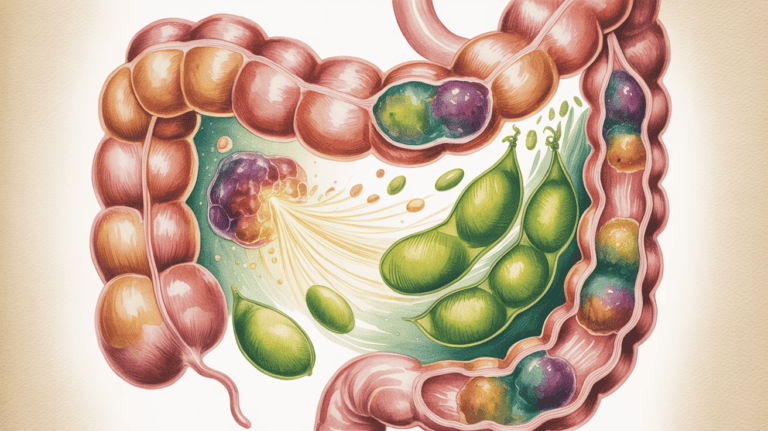
Your digestive tract contains roughly 100 million nerve cells — so many that scientists call it your “second brain.” This network, called the enteric nervous system, stretches from your esophagus to your colon and operates with surprising independence.
But it doesn’t work alone. Your gut communicates with your brain through multiple channels: the vagus nerve (a long nerve that runs directly from your brainstem to your abdomen), your immune system, hormonal signals, and the chemical messengers produced by your gut bacteria themselves.
This entire communication highway is what researchers call the microbiota-gut-brain axis. A 2025 review in Cell Reports Medicine described it as one of the most significant areas of discovery in modern medicine, integrating neural, immune, endocrine, and metabolic pathways — all influencing mood, cognition, and behavior (Cryan et al., 2025).
Here’s the practical takeaway: when your gut microbiome is balanced and diverse, these communication pathways tend to work well. When your gut bacteria are disrupted — a state called dysbiosis — the signals can go haywire. And that disruption doesn’t just cause digestive symptoms. It can contribute to anxiety, depression, brain fog, and systemic inflammation.
The Inflammation Connection You Need to Understand
So what does this have to do with inflammation? Everything.
When your gut microbiome becomes imbalanced, one of the first consequences is increased intestinal permeability — sometimes called “leaky gut.” This means the tight junctions between cells in your intestinal lining loosen, allowing bacterial fragments and inflammatory compounds to slip into your bloodstream.
Once those compounds enter circulation, your immune system responds with inflammation. And that inflammation doesn’t stay local. A 2025 comprehensive review found that this gut-derived inflammation can compromise the integrity of the blood-brain barrier, contributing to neuroinflammation — inflammation in the brain itself (Discover Medicine, 2025).
Think of your gut lining like a security checkpoint. When it’s working well, it lets nutrients through and keeps harmful substances out. When it’s compromised, inflammatory molecules bypass the checkpoint and trigger immune responses throughout your body — including in your brain.
This is why so many women in midlife experience a cluster of seemingly unrelated symptoms: digestive issues, mood changes, brain fog, joint pain, and fatigue. They may look like separate problems, but they often share a common root in gut-driven inflammation.
If you’re curious about how your overall diet contributes to this, I wrote a full guide on what the Dietary Inflammatory Index actually measures and how it applies to your daily food choices.
Why This Matters Even More During Perimenopause and Menopause
Here’s where it gets particularly relevant if you’re in your 40s or 50s. Your gut microbiome and your hormones have a bidirectional relationship — each one influences the other.
You have a specific collection of gut bacteria called the “estrobolome” — bacteria that produce enzymes capable of reactivating estrogen in your digestive tract. When your estrobolome is healthy and diverse, it helps regulate how much active estrogen circulates in your body. A 2022 study of over 1,900 women found that menopause is associated with reduced gut microbial diversity and significant changes to the estrobolome, with implications for cardiometabolic risk (Peters et al., 2022).
As a 2025 review in Frontiers in Endocrinology explained, the relationship goes both ways: declining estrogen levels during menopause directly alter gut microbiome composition, and the altered microbiome further reduces the body’s ability to recycle estrogen — creating a cycle that can worsen menopausal symptoms (Wang et al., 2025).
This is why so many women notice digestive changes during perimenopause that seem to come out of nowhere: bloating, constipation, food sensitivities they didn’t have before. These aren’t “just aging.” They’re signs that your gut ecosystem is shifting along with your hormones.
I explore this hormonal-inflammatory connection in depth in my article on why perimenopause is an inflammatory event — it’s one of the most important pieces I’ve written.
Your Gut Bacteria Make Mood-Regulating Chemicals
This might be the most surprising part of the gut-brain story: your gut bacteria actually produce neurotransmitters — the same chemical messengers your brain uses to regulate mood.
About 90% of your body’s serotonin — the neurotransmitter most associated with feelings of wellbeing and calm — is produced in your digestive tract, not your brain. Your gut microbes also produce GABA (which helps calm anxiety), dopamine (involved in motivation and pleasure), and short-chain fatty acids that directly influence brain function.
When your gut microbiome is disrupted, production of these compounds can shift. A 2024 review found that gut-derived inflammatory signals can alter neurotransmitter synthesis and modulate neuroinflammatory pathways, contributing to conditions ranging from depression to cognitive decline (Zhang et al., 2024).
This doesn’t mean your gut bacteria cause depression or anxiety. But it does mean that supporting your gut health is a legitimate, evidence-based strategy for supporting your mental health — especially during hormonally turbulent times.
What to Eat for a Healthier Gut-Brain Axis
The good news is that your gut microbiome is one of the most modifiable aspects of your health. What you eat has a direct, measurable impact on which bacteria thrive in your gut — and the research is increasingly clear about what helps.
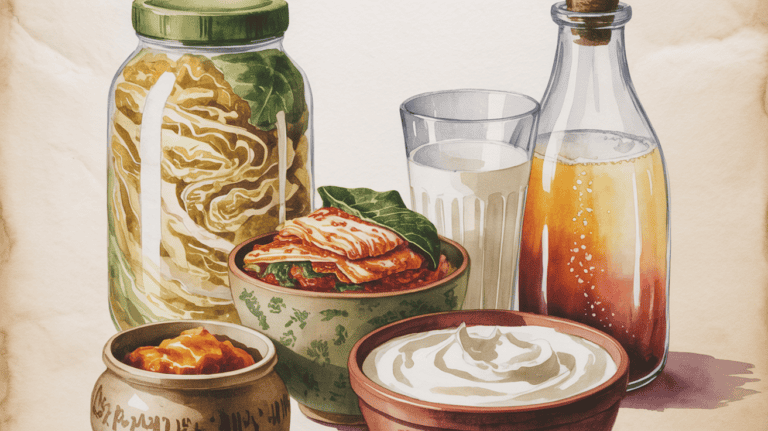
Fermented foods are one of the most powerful tools. A 2021 Stanford study found that a diet high in fermented foods increased microbial diversity and decreased markers of inflammation over just 10 weeks — more effectively than a high-fiber diet alone. Think yogurt with live cultures, kefir, sauerkraut, kimchi, miso, and kombucha. Even small daily amounts make a difference.
I put together a detailed guide on the best fermented foods for menopause — including which ones to prioritize and how to incorporate them into meals you actually enjoy.
Prebiotic fibers feed your beneficial bacteria. These are found in garlic, onions, leeks, asparagus, bananas, oats, and ground flaxseed. If you’ve read my guide on ground flaxseed for menopause, you already know it delivers prebiotic fiber alongside lignans and omega-3s — a triple benefit for gut and hormonal health.
Omega-3 fatty acids from fatty fish, walnuts, and flaxseed support gut barrier integrity and reduce inflammation along the gut-brain axis. I recommend aiming for fatty fish twice a week and adding a daily source of plant-based omega-3s. A quality fish oil supplement can help if you’re not getting enough from food — Nordic Naturals Ultimate Omega is one I recommend to clients.
Polyphenol-rich foods — berries, green tea, dark chocolate, extra virgin
What to reduce: Ultra-processed foods, artificial sweeteners, and excess added sugar have all been shown to reduce microbial diversity and promote inflammatory gut bacteria. This isn’t about perfection — it’s about shifting the balance.
For a week’s worth of meals designed around these principles, check out my 7-day anti-inflammatory meal plan for perimenopause and menopause.
The Stress Side of the Equation
Diet is foundational, but it’s not the only thing that shapes your gut-brain axis. Stress plays an enormous role.
When you’re under chronic stress, your sympathetic nervous system activates your “fight or flight” response. Blood flow diverts away from your digestive system. Digestive enzyme production decreases. Your gut lining becomes more permeable. And the composition of your gut bacteria shifts — often toward less diversity and more inflammatory species.
Then the cycle reinforces itself: the disrupted gut sends inflammatory signals back to the brain, which increases your stress response, which further disrupts the gut. Breaking this cycle requires addressing both sides.
Effective strategies don’t have to be elaborate. Research supports deep breathing exercises, mindfulness meditation, yoga, and even simply eating meals in a relaxed state — without screens, without rushing. These aren’t luxuries. They’re interventions that directly affect your gut physiology.
If stress management feels overwhelming right now, start with one thing: take three slow, deep breaths before you eat. That alone shifts your nervous system toward the “rest and digest” state that your gut needs to function properly.
A Probiotic Supplement: Worth It?
You might be wondering whether a probiotic supplement would help. The honest answer: it depends.
Research on probiotics for mood and gut health is promising but still evolving. Specific strains — particularly Lactobacillus rhamnosus and Bifidobacterium species — have shown benefits for anxiety and depressive symptoms in some clinical trials. But not all probiotics are the same, and many commercial products contain strains that haven’t been specifically studied for gut-brain effects.
If you’re considering a probiotic, look for one with well-studied strains, adequate colony-forming units (CFUs), and third-party testing. But I always tell clients: food first. A diverse, fermented-food-rich diet provides a broader range of beneficial organisms than any single supplement — and comes with fiber, vitamins, and other nutrients your gut needs.
You’re Not Imagining the Connection
If you’ve noticed that your mood, your digestion, and your energy seem to rise and fall together — you’re not imagining it. The gut-brain axis is real, well-documented, and increasingly understood. And the interventions that support it are practical, food-based, and within your control.
You don’t need a perfect diet or a meditation retreat. You need a few consistent habits: fermented foods, prebiotic fibers, omega-3s, less processed food, and moments of calm around meals. These small shifts add up — and they address something that most conventional approaches miss entirely.
If you’re ready to take this conversation to your next medical appointment, I wrote a practical guide on how to talk to your doctor about anti-inflammatory nutrition — including specific questions to ask and how to frame the conversation.
What’s the one gut-friendly change you’ll try this week?
This article is for informational purposes only and is not a substitute for professional medical advice. If you’re experiencing significant digestive or mood symptoms, please work with a qualified healthcare provider. For guidance on having productive conversations with your medical team, see How to Talk to Your Doctor About Anti-Inflammatory Nutrition for Menopause.
References (click to expand)
Cryan, J. F., Clarke, G., Dinan, T. G., et al. (2025). The gut microbiota-immune-brain axis: Therapeutic implications. Cell Reports Medicine, 6(3), 101447. https://doi.org/10.1016/j.xcrm.2025.101447
Discover Medicine. (2025). A comprehensive review on immunological mechanisms and gut-brain pathways linking gut health and neurological disorders. Discover Medicine, 1, 495. https://doi.org/10.1007/s44337-025-00495-3
Peters, B. A., Lin, J., Qi, Q., et al. (2022). Menopause is associated with an altered gut microbiome and estrobolome, with implications for adverse cardiometabolic risk in the Hispanic Community Health Study/Study of Latinos. mSystems, 7(3), e00273-22. https://doi.org/10.1128/msystems.00273-22
Wang, H., Zhang, F., Sang, Y., et al. (2025). Gut microbiota has the potential to improve health of menopausal women by regulating estrogen. Frontiers in Endocrinology, 16, 1562332. https://doi.org/10.3389/fendo.2025.1562332
Zhang, C., Wang, J., Sun, Z., et al. (2024). The communication mechanism of the gut-brain axis and its effect on central nervous system diseases: A systematic review. Biomedicine & Pharmacotherapy, 178, 116888. https://doi.org/10.1016/j.biopha.2024.116888
Sonnenburg, J. L., & Sonnenburg, E. D. (2021). Diet-induced alterations in gut microbiota composition and function. Cell Host & Microbe, 29(7), 1048–1058.