Brain Fog, Memory, and Inflammation: An Anti-Inflammatory Approach to Cognitive Health After 40
A Registered Dietitian’s Evidence-Based Guide to Supporting Your Brain Through Midlife
You’re mid-sentence and the word just… vanishes. You walk into the kitchen and forget why. You read the same paragraph three times. And underneath it all, there’s this quiet fear: Is this normal? Or is something really wrong?
If this sounds familiar, you’re not alone. In the Study of Women’s Health Across the Nation (SWAN), 44% of women in early perimenopause reported new problems with forgetfulness — compared to 31% of premenopausal women. This isn’t in your head. It’s in your hormones, your inflammatory markers, and the way your brain fuels itself during this transition.
And here’s the part that should actually make you feel better: research suggests that for most women, these cognitive changes are related to the hormonal shifts of perimenopause — not early dementia. A 2023 review in Current Psychiatry Reports confirmed that difficulties in verbal learning and memory are the most commonly affected cognitive functions during perimenopause, and that these changes emerge specifically during the transition rather than reflecting permanent decline (Metcalf et al., 2023).
You deserve to know what’s happening and what you can do about it.
Short on Time? Do These Three Things First.
1. Eat fatty fish (salmon, sardines) twice a week — omega-3s directly support brain cell membrane integrity and reduce neuroinflammation.
2. Add a daily serving of berries (blueberries, strawberries) — their polyphenols cross the blood-brain barrier and protect neurons.
3. Prioritize 7–8 hours of sleep — deep sleep is when your brain clears inflammatory waste products.
Start with these. Then come back when you’re ready.
This post may contain affiliate links to products that align with my evidence-based nutrition approach. As an Amazon Associate I earn from qualifying purchases. Full disclosure.
What’s Actually Happening in Your Brain During Perimenopause
Estrogen isn’t just a reproductive hormone — it’s one of the most important neurochemicals your brain relies on. It regulates neurotransmitters including serotonin, dopamine, and acetylcholine (the one most associated with memory and learning). It promotes blood flow to the brain. It supports the growth and maintenance of synapses — the connections between brain cells. And critically, it has potent anti-inflammatory effects in the brain, reducing neuroinflammation that damages neurons.
When estrogen levels fluctuate and decline during perimenopause, all of these functions are affected. A 2024 review in the Journal of Neuroinflammation described how estrogen deficiency disrupts immune homeostasis in the brain, activating inflammatory pathways (particularly the NLRP3 inflammasome and NF-κB signaling) that increase production of inflammatory cytokines like TNF-α, IL-1β, and IL-6 (Zhang et al., 2024). This neuroinflammation can impair communication between brain cells, reduce the brain’s ability to form new connections, and contribute to the foggy, sluggish thinking that characterizes brain fog.
Think of it this way: estrogen was your brain’s built-in anti-inflammatory shield. As it fluctuates, your brain becomes more vulnerable to the effects of inflammation. This is why addressing inflammation — both in the brain and systemically — is one of the most powerful things you can do for cognitive clarity during this transition.
If you haven’t read it yet, I explain the broader inflammatory cascade of perimenopause in my article on perimenopause as an inflammatory event.
The Inflammation–Cognition Connection
Brain fog isn’t just about estrogen — it’s about what happens when inflammation meets a brain that’s already under hormonal stress. Chronic systemic inflammation (the low-grade, ongoing kind driven by diet, stress, poor sleep, and gut health) can cross the blood-brain barrier and fuel neuroinflammation. A 2024 narrative review in Nutrients confirmed that anti-inflammatory diets rich in fruits, vegetables, whole grains, and omega-3s are associated with reduced levels of CRP, IL-6, and TNF-α — all markers linked to cognitive impairment (van Zonneveld et al., 2024).
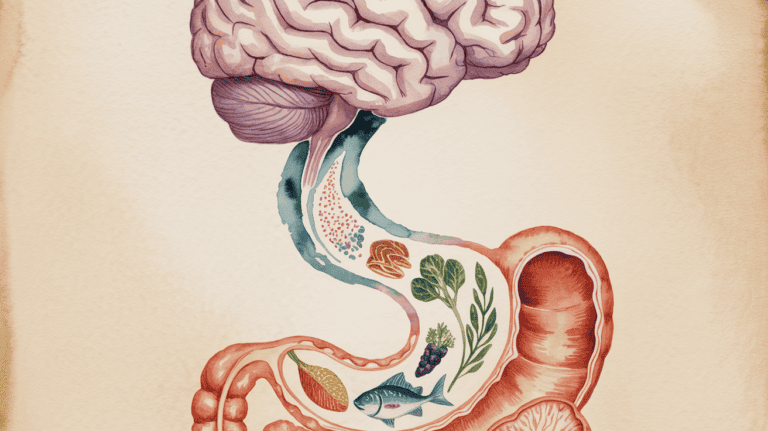
This connection is bidirectional. Your gut microbiome — which shifts during menopause — communicates with your brain through the gut-brain axis, influencing neurotransmitter production, inflammatory signaling, and even mood. I explore this relationship in detail in my article on the gut-brain connection.
The practical takeaway: anything that lowers systemic inflammation also supports your brain. And the dietary patterns with the strongest evidence for cognitive protection are — unsurprisingly — anti-inflammatory.
The Mediterranean Diet and Your Brain: What the Evidence Shows
If there’s one dietary pattern with consistent evidence for brain protection, it’s the Mediterranean diet. A 2025 narrative review in Nutrients summarized how the Mediterranean diet’s high content of omega-3 fatty acids,
The mechanisms go beyond just reducing inflammation. The Mediterranean diet supports cognitive health through multiple pathways: it provides precursors for neurotransmitter production, promotes healthy blood flow to the brain, supports gut microbial diversity (which influences brain function through the gut-brain axis), and provides antioxidants that protect neurons from oxidative damage.
Here’s what’s encouraging: These aren’t hypothetical benefits. Epidemiological studies consistently associate higher adherence to the Mediterranean diet with slower cognitive decline and reduced risk of dementia. And the diet’s components overlap almost entirely with the foods that reduce the Dietary Inflammatory Index score — which means eating to protect your brain and eating to calm inflammation are essentially the same strategy.
The Brain-Supporting Nutrients That Matter Most
Omega-3 Fatty Acids (DHA and EPA)
DHA makes up approximately 40% of the polyunsaturated fatty acids in your brain. It’s essential for maintaining cell membrane integrity, supporting synaptic plasticity (the brain’s ability to form new connections), and reducing neuroinflammation. A 2025 dose-response meta-analysis of 58 randomized controlled trials found that omega-3 supplementation significantly improved attention, processing speed, language, and memory, with benefits increasing at higher doses (Suh et al., 2025).
What to do: Aim for at least two servings of fatty fish per week. If that’s not realistic, consider a quality fish oil supplement providing at least 1,000 mg combined EPA/DHA. Nordic Naturals Ultimate Omega is my standard recommendation.
Polyphenols (Berries, Green Tea, Dark Chocolate, Olive Oil )
Polyphenols are plant compounds that cross the blood-brain barrier and exert direct anti-inflammatory and antioxidant effects in brain tissue. A 2025 review in Frontiers in Molecular Biosciences highlighted how flavonoids from berries reduce neuroinflammation, promote neurogenesis (the formation of new brain cells), and improve communication between neurons (Phytonutrients and Neuroprotection review, 2025).
Blueberries deserve special mention. Multiple studies have shown that regular blueberry consumption improves memory and executive function in older adults, likely through their anthocyanin content — the compounds that give them their deep color.
What to do: Aim for a cup of berries daily (fresh or frozen). Include green tea, extra virgin
B Vitamins (B6, B12, Folate)
B vitamins are essential for neurotransmitter synthesis and for keeping homocysteine levels in check. Elevated homocysteine — which is common in midlife and worsened by B vitamin deficiency — is an independent risk factor for cognitive decline and is pro-inflammatory. I cover this connection in my article on the most common nutrient deficiencies in women over 40.
What to do: Prioritize B-vitamin-rich foods: leafy greens, legumes, eggs, poultry, and fish. Consider a methylated B-complex if you’re concerned about adequacy, especially if you’re vegetarian or take certain medications (like metformin or PPIs) that affect B12 absorption.
Magnesium
Magnesium supports over 300 enzymatic reactions in the body, including those involved in neurotransmitter function and blood-brain barrier integrity. Deficiency is associated with increased neuroinflammation, anxiety, poor sleep, and cognitive impairment — all complaints common in perimenopause. Doctor’s Best Magnesium Glycinate is well-absorbed and less likely to cause digestive issues.
Beyond Diet: The Lifestyle Factors That Protect Your Brain
Sleep is non-negotiable for cognitive function. During deep sleep, your brain activates the glymphatic system — essentially a cleaning crew that clears inflammatory waste products and metabolic debris. When sleep is disrupted (as it so often is during perimenopause), this process is impaired, and inflammatory buildup accelerates. If sleep is a struggle, see my article on tart cherry juice for sleep.
Movement increases blood flow to the brain, promotes the release of brain-derived neurotrophic factor (BDNF) — which supports neuronal growth and repair — and reduces systemic inflammation. Even a 20-minute daily walk has been shown to improve cognitive function.
Social connection is an underappreciated brain protector. The 2024 Lancet Commission on dementia prevention added social isolation as a modifiable risk factor for cognitive decline. Meaningful conversation requires complex cognitive processing — attention, memory retrieval, language production — and provides natural cognitive stimulation.
Stress reduction matters because chronic stress elevates cortisol, which at sustained high levels is directly toxic to the hippocampus — the brain region most critical for memory and learning.
What to Eat This Week for Brain Clarity
Here’s a practical framework to support cognitive function through anti-inflammatory nutrition:
| Meal | Brain-Supporting Focus |
|---|---|
| Breakfast | Eggs with spinach and a sprinkle of turmeric; ground flaxseed in yogurt |
| Lunch | Large salad with leafy greens, walnuts, berries, and |
| Snack | A cup of green tea with a handful of almonds or dark chocolate |
| Dinner | Baked salmon with roasted vegetables; fermented side (kimchi or sauerkraut) |
For a complete week of meals built around these principles, see my 7-day anti-inflammatory meal plan.
The Part That Matters Most
Brain fog during perimenopause is real, it’s common, and for most women, it’s temporary. Research from the SWAN study suggests that cognitive difficulties are most pronounced during the late perimenopause transition and typically stabilize in the postmenopausal period.
That doesn’t mean you have to just wait it out. The evidence is clear that reducing inflammation — through what you eat, how you sleep, and how you manage stress — directly supports the brain functions most affected during this transition.
You’re not losing your mind. Your brain is navigating a major biological shift, and it needs specific support right now. The fact that you’re seeking this information puts you ahead of most of the advice out there.
What’s one brain-supporting change you’ll make this week?
This information is for educational purposes and is not a substitute for personalized medical advice. If you have concerns about your cognitive function, talk with your healthcare provider. For guidance on having that conversation, see my article on how to talk to your doctor about anti-inflammatory nutrition for menopause.
References (click to expand)
Metcalf, C. A., Duffy, K. A., et al. (2023). Cognitive problems in perimenopause: A review of recent evidence. *Current Psychiatry Reports*, 25(10), 501–511. https://doi.org/10.1007/s11920-023-01447-3
Zhang, Y., et al. (2024). Estrogen deficiency and neuroinflammation in menopausal depression. *Journal of Neuroinflammation*, 21, 159. https://doi.org/10.1186/s12974-024-03152-1
van Zonneveld, S. M., et al. (2024). An anti-inflammatory diet and its potential benefit for individuals with mental disorders and neurodegenerative diseases — A narrative review. *Nutrients*, 16(16), 2646. https://doi.org/10.3390/nu16162646
Suh, S. W., Lim, E., et al. (2025). A systematic review and dose-response meta-analysis of omega-3 fatty acids and cognitive function. *Scientific Reports*, 15, 16129. https://doi.org/10.1038/s41598-025-16129-8
Picone, P., et al. (2024). Enriching the Mediterranean diet could nourish the brain more effectively. *Frontiers in Nutrition*, 11, 1489489. https://doi.org/10.3389/fnut.2024.1489489
Weber, M. T., et al. (2022). Brain fog in menopause: A health-care professional’s guide for decision-making and counseling on cognition. *Climacteric*, 25(6), 574–580. https://doi.org/10.1080/13697137.2022.2122792