Hypothyroidism and Inflammation: Foods That Support Your Thyroid (and Why It Matters After 40)
An Evidence-Based Guide from a Registered Dietitian — Because Fatigue, Weight Changes, and Brain Fog Deserve a Better Explanation Than “It’s Your Age”
If you’re in your forties and dealing with fatigue that sleep doesn’t fix, unexplained weight changes, brain fog, thinning hair, feeling cold when everyone else is comfortable, constipation, or a mood that feels heavier than your circumstances warrant — you may have been told these are normal signs of aging. Or perimenopause. Or stress.
And those things could be contributing. But there’s another possibility that deserves investigation: your thyroid may not be producing enough hormone.
Hypothyroidism — an underactive thyroid — affects up to 5% of the general population, with an estimated additional 5% undiagnosed. Women are significantly more likely to develop it, and the risk increases with age, particularly after 40. The most common cause in the United States is Hashimoto’s thyroiditis — an autoimmune condition where the immune system gradually attacks the thyroid gland.
Here’s the part that connects everything: Hashimoto’s is fundamentally an inflammatory disease. And the emerging research suggests that the nutrients you eat, the inflammatory load of your diet, and specific micronutrient levels all influence how this condition behaves.
Short on Time? Start With These Three Things.
- Ask your doctor to check your thyroid panel AND your vitamin D and selenium levels — a basic TSH alone often isn’t enough, and both nutrients directly affect thyroid function and inflammation.
- Add selenium-rich foods to your diet — two to three Brazil nuts daily provide your full daily selenium needs. A 2024 meta-analysis found selenium supplementation reduces thyroid antibodies in Hashimoto’s patients.
- Take your thyroid medication correctly — on an empty stomach with water, then wait 30-60 minutes before eating or taking supplements containing calcium, iron, or magnesium.
- Consider targeted thyroid support. If you are looking for a more comprehensive option, Thorne Thyroid Health is a convenient thyroid support supplement that combines key nutrients and herbs commonly used to support healthy thyroid function. It is not a replacement for prescription thyroid medication, but it may be a helpful add-on for some people alongside a nutrient-dense anti-inflammatory diet.
This post may contain affiliate links to products that align with my evidence-based nutrition approach. As an Amazon Associate I earn from qualifying purchases. Full disclosure.
Your Thyroid: What It Does and Why It Matters
Your thyroid is a small butterfly-shaped gland at the front of your neck that produces hormones controlling your metabolism — essentially, how fast or slow your body runs. Thyroid hormones influence your heart rate, body temperature, energy expenditure, brain function, digestion, mood, and even how quickly your hair grows and your skin regenerates.
When thyroid hormone levels are too low, everything slows down. That’s why hypothyroidism produces such a wide and seemingly unrelated collection of symptoms — weight gain, fatigue, constipation, cold sensitivity, dry skin, thinning hair, depression, and difficulty concentrating. These aren’t separate problems. They’re all downstream effects of the same hormonal deficiency.
The Hashimoto’s and Inflammation Connection
Hashimoto’s thyroiditis accounts for the vast majority of hypothyroidism cases in the United States. It’s an autoimmune condition — your immune system produces antibodies (TPOAb and TgAb) that attack your own thyroid tissue, causing chronic inflammation of the gland and gradually reducing its ability to produce hormones.
A 2024 study in Scientific Reports confirmed that thyroid antibody levels in Hashimoto’s patients are positively associated with systemic inflammation — patients with higher antibody levels showed higher levels of pro-inflammatory markers throughout the body, not just in the thyroid (Li et al., 2024).
This means Hashimoto’s isn’t just a thyroid problem. It’s a whole-body inflammatory condition that happens to target the thyroid.
And here’s why this matters for your diet: if you can reduce the inflammatory drivers that fuel the autoimmune attack, you may be able to slow the progression, reduce antibody levels, and support better thyroid function — alongside your prescribed medication.
Where Perimenopause and Hypothyroidism Overlap
The timing is not a coincidence. Thyroid disorders become significantly more common during the perimenopausal transition, and the symptoms of hypothyroidism and perimenopause overlap extensively — fatigue, weight changes, mood shifts, brain fog, sleep disruption, and hair thinning.
This overlap means that many women are told their symptoms are “just perimenopause” when in fact their thyroid is also contributing. If you’re in your forties or fifties and experiencing these symptoms, getting a thorough thyroid panel (not just TSH) is important. I cover how to advocate for comprehensive testing in my article on how to talk to your doctor about anti-inflammatory nutrition.
The inflammatory mechanism links both conditions: perimenopause itself is an inflammatory event, and that increased systemic inflammation can worsen autoimmune thyroid disease. Addressing the inflammation serves both conditions simultaneously.
Key Nutrients for Thyroid Health
Selenium: The Evidence Is Compelling
Selenium is an essential trace mineral required for thyroid hormone production. Your thyroid gland has the highest concentration of selenium of any organ in your body, and selenium-containing enzymes (selenoproteins) are critical for converting T4 (inactive thyroid hormone) to T3 (the active form your body uses).
A landmark 2024 systematic review and meta-analysis of 35 randomized controlled trials — involving over 2,300 Hashimoto’s patients — found that selenium supplementation significantly reduced TPOAb (thyroid peroxidase antibodies) and lowered TSH in patients not yet on thyroid hormone replacement. The authors concluded that selenium supplementation “is safe and holds potential as a disease-modifying factor for Hashimoto’s-associated hypothyroidism” (Huwiler et al., 2024).
How to get it:
– Brazil nuts are the most concentrated food source — just 2-3 nuts per day typically provides 100-200 mcg of selenium (the recommended daily intake is 55 mcg for adults)
– Seafood, eggs, turkey, chicken, and sunflower seeds are also good sources
– If supplementing, selenomethionine (the organic form) has better bioavailability than sodium selenite
– Do not exceed 400 mcg daily — excess selenium can actually worsen thyroid function
A reasonable supplement option: Thorne Selenium provides 200 mcg selenomethionine per capsule.
Iodine: Essential but Nuanced
Iodine is the literal building block of thyroid hormones — the “T” in T3 and T4 refers to the number of iodine atoms attached. Iodine deficiency causes hypothyroidism, and it remains the most common cause of thyroid dysfunction worldwide.
However, in the United States, most people get adequate iodine from iodized salt, dairy, eggs, and seafood. And here’s the critical nuance: in Hashimoto’s patients, excess iodine can worsen the autoimmune attack on the thyroid.
What to do:
– Ensure you’re getting adequate iodine (150 mcg daily for adults) through food — iodized salt, dairy, eggs, fish, and seaweed in moderate amounts
– Don’t take high-dose iodine supplements without medical supervision, especially if you have Hashimoto’s
– If you’ve switched to sea salt, pink Himalayan salt, or other specialty salts, know that these typically contain very little iodine
Vitamin D
Vitamin D deficiency is significantly more common in Hashimoto’s patients than in the general population, and a 2023 randomized controlled trial found that vitamin D supplementation improved thyroid function and reduced antibody levels in Hashimoto’s patients (Jiang et al., 2023).
Vitamin D modulates immune function and has direct anti-inflammatory effects. Given that Hashimoto’s is fundamentally an immune-mediated inflammatory condition, maintaining adequate vitamin D levels makes biological sense.
What to do: Get your 25-hydroxyvitamin D level tested. Most functional medicine practitioners aim for 40-60 ng/mL. Supplementation of 2,000-4,000 IU daily is common when levels are low.
Iron
Iron deficiency can impair thyroid hormone synthesis and is common in women, particularly those with heavy periods. A 2024 NHANES analysis found an inverse association between serum iron levels and Hashimoto’s thyroiditis in reproductive-age women — lower iron correlated with higher prevalence of the condition (Zhang et al., 2024).
Don’t supplement iron without testing — excess iron has its own risks. But if your levels are low, addressing the deficiency may improve thyroid function and reduce the fatigue that’s so characteristic of hypothyroidism.
Zinc
Zinc is required for thyroid hormone synthesis and T3 receptor function. A randomized trial found that combined zinc and selenium supplementation improved thyroid function in overweight hypothyroid women. Food sources include oysters, beef, pumpkin seeds, chickpeas, and cashews.
Anti-Inflammatory Eating for Thyroid Health
Beyond individual nutrients, the overall inflammatory quality of your diet matters for thyroid health — particularly in Hashimoto’s.
A 2025 review in Nutrients concluded that dietary patterns rich in selenium, omega-3 fatty acids, iodine, and antioxidants — particularly the Mediterranean dietary pattern — may help modulate the immune responses and oxidative stress implicated in Hashimoto’s disease (Mazur et al., 2025).
Foods That Support Thyroid Function
- Selenium-rich foods: Brazil nuts, seafood, eggs, turkey, sunflower seeds
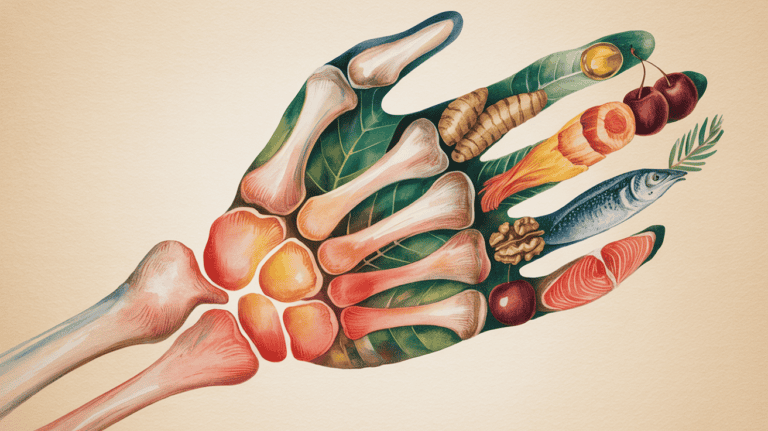
- Omega-3 fatty acids: Salmon, sardines, mackerel, ground flaxseed, walnuts — reduce systemic inflammation
- Colorful fruits and vegetables: The antioxidant polyphenols counter oxidative stress in the thyroid gland
- Fermented foods: Yogurt, kefir, kimchi, sauerkraut — support the gut microbiome, which influences immune function and autoimmunity. I have a full guide on the best fermented foods and their benefits.
- Extra virgin
olive oil : Anti-inflammatory oleocanthal supports overall immune modulation - Adequate protein: Tyrosine, an amino acid found in protein-rich foods, is also needed for thyroid hormone production
Foods and Substances to Be Thoughtful About
Goitrogens: Cruciferous vegetables (broccoli, cauliflower, kale, cabbage) and soy contain compounds called goitrogens that, in very large raw quantities, can interfere with iodine uptake by the thyroid. However — and this is important — the research does not support avoiding these foods. They are some of the most nutrient-dense, anti-inflammatory foods available. Cooking reduces goitrogen content significantly. Eat them. Just don’t consume massive raw quantities exclusively.
Regarding soy specifically: soy foods do not cause thyroid problems in people with normal thyroid function and adequate iodine. In people taking thyroid medication, soy can interfere with absorption — which is why medication should be taken on an empty stomach. I’ve written extensively about soy safety and the evidence if you want the full picture.
Ultra-processed foods: These are pro-inflammatory across the board and can worsen the systemic inflammation driving Hashimoto’s.
Gluten: There is a well-established association between celiac disease and Hashimoto’s. If you have both conditions, a gluten-free diet is medically necessary. For Hashimoto’s patients without celiac disease, the evidence for gluten-free eating is less clear — some patients report improvement, but controlled studies haven’t consistently shown benefits. If you’re curious, a monitored elimination trial with your dietitian is a reasonable approach.
Taking Thyroid Medication: What You Need to Know About Food Timing
If you’re on levothyroxine (Synthroid, Levoxyl, or generic), how and when you take it matters:
- Take it on an empty stomach with water — ideally first thing in the morning
- Wait 30-60 minutes before eating or drinking anything other than water
- Wait at least 4 hours before taking supplements containing calcium, iron, or magnesium — these can significantly reduce absorption
- Avoid consuming grapefruit or grapefruit juice — it can interact with medication absorption
- High-fiber meals, soy, walnuts, and coffee can also reduce absorption if consumed too close to your dose
This is one of the most practical things you can do for your thyroid health. All the dietary improvements in the world are undermined if your medication isn’t being absorbed properly.
A Practical Starting Framework
| Time Frame | Action |
|---|---|
| This week | Start eating 2-3 Brazil nuts daily for selenium. Take your thyroid medication correctly (empty stomach, wait 30-60 min). |
| Week 2-3 | Add omega-3 rich foods (fish 2x/week, ground flaxseed daily). Increase colorful produce. Switch to extra virgin |
| Month 1 | Request comprehensive thyroid panel + vitamin D + iron + selenium from your doctor. Begin magnesium glycinate before bed. |
| Month 2-3 | Follow a 7-day anti-inflammatory meal plan for structure. Track energy, mood, and symptoms. Consider anti-inflammatory swaps for common household staples. |
You Deserve Comprehensive Care
Hypothyroidism — especially Hashimoto’s — is not just a “take this pill” condition. The medication is important, often essential, and I’d never suggest otherwise. But medication alone addresses the hormone deficiency without addressing the inflammatory autoimmune process that caused it.
An anti-inflammatory approach addresses both: it supports the body’s ability to use the medication you’re taking, while also reducing the immune system activation that’s damaging the thyroid in the first place.
If you’ve been told your symptoms are “normal for your age” — or if your TSH is “technically normal” but you still feel terrible — you deserve a more thorough investigation. And you deserve to know that nutrition is a real, evidence-based tool in this picture.
What’s the one thing you’ll start with this week?
This content is for educational purposes and is not a substitute for individualized medical advice. Never adjust or stop thyroid medication without consulting your healthcare provider. If you need help advocating for comprehensive testing, see my guide on how to talk to your doctor about anti-inflammatory nutrition.
References (click to expand)
Mazur, M., Szymańska, M., Malik, A., Szlasa, W., & Popiołek-Kalisz, J. (2025). Nutrition and micronutrient interactions in autoimmune thyroid disorders: Implications for cardiovascular health. *Pathophysiology*, 32(3), 37. https://doi.org/10.3390/pathophysiology32030037
Huwiler, V. V., et al. (2024). Selenium supplementation in patients with Hashimoto thyroiditis: A systematic review and meta-analysis of randomized clinical trials. *Thyroid*, 34(3), 295-313. [https://doi.org/10.1089/thy.2023.0556](https://doi.org/10.1089/thy.2023.0556)
Jiang, X., Huang, Y., Li, Y., Xia, Y., Liu, L., Lin, F., & Shi, Y. (2023). Therapeutic effect of vitamin D in Hashimoto’s thyroiditis: a prospective, randomized and controlled clinical trial in China. *American Journal of Translational Research*, 15(10), 6234-6241. PMID: 37969187.
Larsen, C., et al. (2024). Selenium supplementation and placebo are equally effective in improving quality of life in patients with hypothyroidism. *European Thyroid Journal*, 13(1). [https://doi.org/10.1530/ETJ-23-0175](https://doi.org/10.1530/ETJ-23-0175)
Li, J., et al. (2024). Thyroid antibodies in Hashimoto’s thyroiditis patients are positively associated with inflammation and multiple symptoms. *Scientific Reports*, 14, 27902. [https://doi.org/10.1038/s41598-024-78938-7](https://doi.org/10.1038/s41598-024-78938-7)
Zhang, L., et al. (2024). Inverse association between serum iron levels and Hashimoto’s thyroiditis in United States females of reproductive age: Analysis of the NHANES 2007-2012. *Frontiers in Nutrition*, 11, 1410538. [https://doi.org/10.3389/fnut.2024.1410538](https://doi.org/10.3389/fnut.2024.1410538)